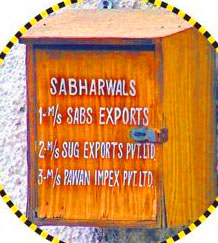
This started it all
The letterbox was decidedly old. Its brown shabbiness gave no indication of the wealth, or the status of the inhabitants of the house.
And yet, it was the mark of Cain. A clue, it hung there, outside the house of the then Chief Justice of India Y K Sabharwal. So like a faded prostitute seeking a rendevouz – inviting a look that went beyond the wrinkled skin and drooping breasts. In vain…
But I had gone to see that very letterbox, to coax it to tell the story it silently screamed to each and every passerby on the street. “That Sabharwal has ordered the demolition of thousands of shops because they are in residential premises. But he is running companies from his own house,” I was told the previous night as I climbed the stairs to my bedroom. The conversation was one of many such I was used to having with my in-laws while entering or exiting the house. The day’s rants and raves which keep a family bonded, and on the same page.
But this was different. “What do you mean?” I asked. “You should see the letterbox outside his house. It has the names of so many companies. Look at this man! He is running companies from his own house while getting the houses of others demolished for doing the same,” I was told.
The indignant ‘whistle-blower’ was my husband’s older brother whose eagle eye had scanned the letterbox as he waited with some others outside Sabharwal’s house that morning to collect a donation for the local temple. My husband’s family and the Sabharwals were refugees from Pakistan and, like many others, had found shelter in Punjabi Bagh after the Partition brought them to India. As they struggled to recreate their shattered lives, the residents of the colony clung together through temples, Gurudwaras, and shared religious activities. Sabharwal’s mother and my husband’s mom used to be together at prayer meetings. Later, the Sabharwals became a symbol of success for the displaced lot when their younger son, Yogendra, became the Chief justice of India. While he shifted to an official bungalow, one of his brothers continued to live in the family home at 3/81, Punjabi Bagh. The CJI’s official car, with its elaborate security, was often spotted outside the bungalow on weekends, keeping interest alive in one of the most successful families of the area.
Noj for Newj
‘Noj for Newj’ – It was a phrase used time and again in my journalism school by a professor with a slight pronunciation issue. An outstanding Hindi journalist, he impressed upon his class that this ‘noj’ was something a reporter just couldn’t do without. As I stood outside Sabharwal’s bungalow in early dawn the next day, that nose twitched. Three names were hand-painted on the faded brown letterbox outside his family home. These were SABS Export, Pawan Impex, and Sug Export.
The white paint was stark against that dull brown, staring at the world with the confidence that it would find no challenger.
I could hardly believe my eyes.This couldn’t be true. How could the house of the Chief Justice of India be used for running commercial establishments? How could the man who was leading a campaign against commercialization of residential premises, run commercial companies from his own residence? Justice Sabharwal had been a knight on a white charger, wreaking the wrath of law on the unlawful. Thousands of buildings lay reduced to heaps of rubble in Delhi because he had forced the civic body to take action against unscrupulous traders and builders who ran their business from illegal premises.
It was Justice Sabharwal who had said in his order setting out the process for sealing of shops that: “Rule of law is the essence of Democracy. It has to be preserved. Laws have to be enforced.”
How could he be letting the law be transgressed in his own backyard then! It was beyond belief.
My first reaction was to seek out my colleagues- reporter M K Tayal and photographer Rajiv Tyagi. We decided Rajiv would come by at 5 am the next day to click pictures of the letterbox. Early morning hours would give Rajiv the light he needed, and the secrecy I was keen on.
Rajiv took the pictures the next day, as my husband and I warily looked out for passers by. We didn’t want to alert the inmates of the house to the letterbox that told tales. Later, as we sat together over breakfast, the enormity of the issue hit us hard.
Neither one of us was afraid, or had an iota of doubt about the story we had started to chase. To the contrary, we were outraged and wanted the world to know the terrible duplicity at work in the demolitions. It was incredible that the all-powerful CJI would allow commercial companies to be run from his house and yet, set the state machinery after others guilty of similar violation of law. MCD bulldozers were running amok in Delhi, razing to the ground multi-storey buildings, markets and shops which had sprung up in residential areas. The city appeared to have been carpet bombed, ripped open for a crime beyond redemption, its gaping wounds bleeding bricks and mortar.
Delhi was a sea of rubble, in which we had chanced upon an island of impunity- the house of Justice Y K Sabharwal.
To Be Continued
Next – INJUSTICE


Gripping story. The narrative takes me along effortlessly. Waiting to read more.
LikeLike
Thanks, Sandhya! More this evening and I hope you like it!
LikeLike